
The triquetra (often, triqueta) is a tripartate symbol composed of three interlocked vesica pisces, marking the intersection of three circles. It is most commonly a symbol of the Holy Trinity (Father, son, Holy spirit) used by the Celtic Christian Church, sometimes stylized as three interlaced fish.
The triqueta symbol predates Christianity and was likely a Celtic symbol of the Goddess, and in the North, a symbol of the god Odin. Although it is often asserted that the triquetra is a symbol of a tripartite goddess, no such goddess has been identified with the symbol. Similar symbols do occur in some Norse and Celtic goddess imagery, but most likely represents the divisions of the animal kingdom and the three domains of earth mentioned above. Triplicities were common symbols in Celtic myth and legend, one of the possible reasons Christian beliefs were so easily adopted by the Celtic people.

The triqueta makes an ideal Christian symbol. It is a perfect representation of the concept of "three in one" in Christian trinity beliefs, and incorporates another popular Christian symbol, the fish, in its original form of the vesica pisces. It is sometimes enclosed within a circle to emphasize the unity aspect.
In Wiccan and Neopagan belief, the triqueta symbolizes the triple aspected goddess (maid, mother, and crone). Some Christians have protested this "appropriation" of the symbol...however, ironically enough, the original Christian fish symbol was derived from an early symbol of venus, one representing female generative organs- making the triquetra perfectly appropriate symbol for a Goddess revival. The triquetra is also considered to represnt the triplicities of mind, body, and soul, as well as the three domains of earth according to Celtic legend- earth, sea, and sky.
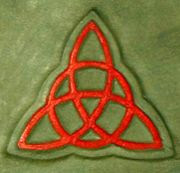
The triquetra also appears on the television series
Charmed, probably as a less threatening alternative to the pentacle (the preferred emblem of witches real and imaginary). In the show, it represents the "power of three, acting as one which in turn represents the three sisters.
The triquetra also appears on the motion picture Constantine as a charm used by a catholic priest to protect against demons.
The
triskele, or
triple spiral, or
triskelion, a symbol closely related to the triquetra, is a tripartite symbol

composed of three interlocked
spirals. The spiral is an ancient Celtic symbol related to the sun, afterlife and reincarnation. The example above comes from the Neolithic "tomb" at Newgrange, where it is supposed by some to be a symbol of pregnancy (the sun describes a spiral in its movements every three months; a triple spiral represents nine months), an idea reinforced by the womb like nature of the structure. The symbol also suggests reincarnation- it is drawn in one continuous line, suggesting a continuous movement of time.
Triskeles are one of the most common elements of Celtic art; they are found in a variety of styles in both ancient and modern Celtic art, especially in relation to depictions of the Mother Goddess. They also evoke the Celtic concept of the domains of material existence- earth, water, and sky, and their interrelations.
The
trinacria, a three legged design resembling a triskele, is a symbol of the Isle of Sicily.
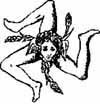
"Trincaria" means "triangular," and the three points represent the three capes of Sicily, also known as Trinacria in ancient times.
The Medusa in the center implies the protection of the Goddess Athena, the Patron Goddess of the Isle. (In early mythology, Medusa was the destructive aspect of Athena, later, a monster slain by the hero Perseus, who adorned Athena's shield.)

 scratched into rocks from thousands of years ago, on every continent in the world. The religious significance can only be guessed, but it has been found on tombs, and possibly has a connection with the sun- the sun makes a spiral shape every three months in its travels.
  scratched into rocks from thousands of years ago, on every continent in the world. The religious significance can only be guessed, but it has been found on tombs, and possibly has a connection with the sun- the sun makes a spiral shape every three months in its travels.
  A triple spiral motif found on Celtic tombs is drawn unicursally (that is, in one continuous line), suggesting a cycle of rebirth or resurrection. (this hypothesis is bolstered by the fact that many of these appear to be deliberately placed where they catch the first rays of the sun on the solstice).


