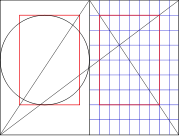
Tschichold's "golden canon of page construction" here illustrated by a synthesis of Tschichold's figure thereof, with the diagonals and circle, combined with Rosarivo's construction by division of the page into ninths. These two constructions rely on the 2:3 page ratio to give a type area height equal to page width as demonstrated by the circle, and result in margin proportions 2:3:4:6. For other page ratios, Rosarivo's method of ninths is equivalent to van de Graaf's canon, as Tschichold observed.

Medieval manuscript framework according to Tschichold, in which a text proportion near the
golden ratio is realized on a 2:3 page proportion.

Tschichold's drawing of an octavo-format page proportioned in the golden ratio or golden section "34:21". The text area and margin proportions are determined by the starting page proportions.
Building on Rosarivo's work, contemporary experts in book design such as Jan Tschichold and Richard Hendel, assert as well that the page proportion of the
golden section (21:34), has been used in
book design, in manuscripts, and
incunabula, mostly in those produced between 1550 and 1770. Hendel writes that since Gutenberg's time, books have been most often printed in an upright position, that comform losely, if not precisely, to the golden ratio.
Tschichold's drawing of an octavo-format page proportioned in the
golden ratio or golden section "34:21". The text area and margin proportions are determined by the starting page proportions.
These page proportions based on the golden section or golden ratio, are usually described through its
convergents such as 2:3, 5:8, and 21:34.
Tschichold says that common ratios for page proportion used in book design include as 2:3, 1:√3, and the golden section. The image with circular arcs depicts the proportions in a medieval manuscript, that according to Tschichold feature a "Page proportion 2:3. Margin proportions 1:1:2:3. Text area in accord with the Golden Section. The lower outer corner of the text area is fixed by a diagonal as well." By accord with the golden section, he does not mean exactly equal to, which would conflict with the stated proportions.
Tschichold refers to a construction equivalent to van de Graaf's or Rosarivo's with a 2:3 page ratio as "the Golden Canon of book page construction as it was used during late Gothic times by the finest of scribes." For the canon with the arc construction, which yields a text area ratio closer to the golden ratio, he says "I abstracted from manuscripts that are older yet. While beautiful, it would hardly be useful today."
Of the different page proportions that such a canon can be applied to, he says "Book pages come in many proportions, i.e. relationships between width and height. Everybody knows, at least from hearsay, the proportion of the Golden Section, exactly 1:1.618. A ratio of 5:8 is no more than an approximation of the Golden Section. It would be difficult to maintain the same opinion about a ratio of 2:3."
And he expresses a preference for certain ratios over others: "The geometrically definable irrational page proportions like 1:1.618 (Golden Section), 1:√2, 1:√3, 1:√5, 1:1.538, and the simple rational proportions of 1:2, 2:3, 5:8 and 5:9 I call clear, intentional and definite. All others are unclear and accidental ratios. The difference between a clear and an unclear ratio, though frequently slight, is noticeable. ... Many books show none of the clear proportions, but accidental ones."
John Man's quoted Gutenberg page sizes are in a proportion not very close to the golden ratio, but Rosarivo's or van de Graaf's construction is applied by Tschichold to make a pleasing text area on pages of arbirary proportions, even such accidental ones.

 spiral is made from quarter-circles tangent to the interior of each square, while the red spiral is a Golden Spiral, a special type of logarithmic spiral. Overlapping portions appear yellow. The length of the side of a larger square to the next smaller square is in the golden ratio. (A Fibonacci spiral is not shown, but could be constructed from a similar "whirling rectangle diagram", in which the ratios of the rectangles were based on the terms in the Fibonacci series, rather than phi.)


