
In Pagan times, this glyph was associated with the Goddess Venus, and  represented female genitalia. Early depictions of Christ depict him as an infant within the vesica (usually called a mandorla, meaning 'almond shaped.'), which represented the womb of Mary (and often, the coming together of heaven and earth in the body of jesus- part man, part god). As such, it is also a doorway or portal between worlds, and symbolizes the intersection between the heaven and the material plane. The shape of arches in gothic architecture is based on the vesica.
 represented female genitalia. Early depictions of Christ depict him as an infant within the vesica (usually called a mandorla, meaning 'almond shaped.'), which represented the womb of Mary (and often, the coming together of heaven and earth in the body of jesus- part man, part god). As such, it is also a doorway or portal between worlds, and symbolizes the intersection between the heaven and the material plane. The shape of arches in gothic architecture is based on the vesica.
 The shape of the vesica pisces is derived from the intersection of two circles, the Pythagorean "measure of the fish" that was a mystical symbol of the intersection of the world of the divine with the world of matter and the beginning of creation. To the Pythagoreans, the whole of creation was based on number, and by studying the properties of number, they believed one could achieve spiritual liberation. The vesica pisces was the symbol of the first manifestation, the dyad (reflection) that gives birth to the entire manifest universe. Within the vesica can be found the triangle, the tetrad, the square, the pentacle, and many more polygons, making the vesica a true symbolic womb.
 The vesica pisces is the main part of the design that graces the cover 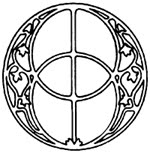 of the Chalice Well at Glastonbury, designed in the nineteenth century by archaeologist Bligh Bond. Crafted of wrought iron and wood, it depicts the vesica pisces, a symbol of the divine feminine, and Excalibur, the sword of the legendary King Arthur, who is believed by some to be buried at Glastonbury.
 of the Chalice Well at Glastonbury, designed in the nineteenth century by archaeologist Bligh Bond. Crafted of wrought iron and wood, it depicts the vesica pisces, a symbol of the divine feminine, and Excalibur, the sword of the legendary King Arthur, who is believed by some to be buried at Glastonbury.
 The wellspring at Glastonbury is considered to be one of England's most Holy sites. The well itself dates back over two thousand years, and was sacred to both early Pagans and the Christians who later built an abbey on the site. Today, the well is a place of pilgrimage for Christians and Pagans alike, many of whom believe the red, iron rich water has healing and miraculous properties. The vesica Pisces theme is repeated in the shape of the pool at the base of the hill, where the water from the spring flows.
An old legend holds that after the crucifixion, Joseph of Arimathea travelled to England and hid the Holy Grail on the premises, accounting for the water's red hue. Modern Neopagans who use the site equate the waters with the menstruum of the Goddess.


